Sourcing focus
Each review starts with the application, then works through material, coating, magnetization, validation, origin, and production requirements.
Choose the shape around the assembly
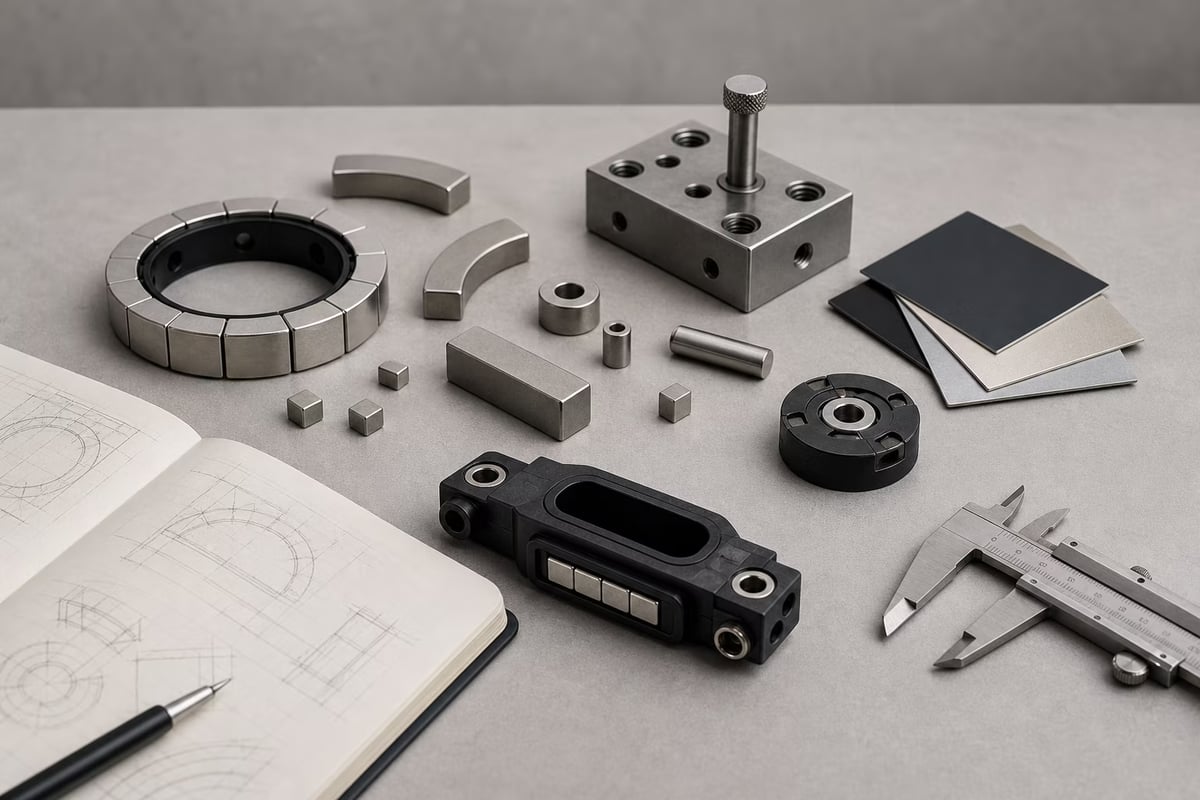
Blocks, discs, rings, arcs, segments, and custom machined geometries should be defined around the available space and magnetic circuit. Include the dimensions that control fit and alignment. For a ring or arc, specify the relevant diameters, thickness, length or angle, and any orientation features clearly.
Identify critical dimensions and edge conditions
Separate critical-to-function dimensions from general tolerances. Show chamfers, radii, countersunk features, and acceptable edge conditions where needed. State how coating buildup is handled in the finished dimensions and review clearance, adhesive gaps, brittle edges, and handling alongside the geometry.
Separate material grade from magnetic acceptance
A grade callout and a finished-part measurement serve different purposes. Record the material requirement alongside the application output, operating temperature, and measurement method. The agreed acceptance criteria should describe what will be checked on the magnet or finished assembly.
Make magnetization unambiguous
Show axial, diametric, radial, or multi-pole requirements on the drawing, including pole locations and polarity where relevant. Agree on the magnetization and measurement setup before sampling. Include any polarity marking or orientation feature needed to keep assembly consistent.
Match the coating to the assembly environment
Review corrosion exposure, adhesive bonding, overmolding, press-fit contact, cleanliness, and cosmetic requirements when selecting a coating. Candidate options already considered in NdFeB sourcing include NiCuNi, epoxy, zinc, parylene, e-coat, and encapsulation. The selected protection and validation should fit the actual use.
Define the sample measurement
Specify whether acceptance is based on surface gauss, flux, pull force, torque, or an application-level sensor response. Record the test position, air gap or fixture conditions, units, and acceptable output window as relevant. This lets the sample discussion distinguish a geometry problem from a measurement or magnetic-circuit issue.