Are neodymium magnets the same as rare earth magnets?
Neodymium magnets are one family of rare earth magnets. Samarium cobalt (SmCo) is another. NdFeB describes neodymium iron boron; rare earth does not mean every rare earth magnet has the same composition or temperature behavior.
What are neodymium magnets used for?
Common uses include compact electric motors, sensors, actuators, latches, holding devices, and magnetic assemblies where high output is needed in limited space. Selection depends on the complete magnetic circuit and operating environment.
Is N52 always better than N42?
N52 has a higher maximum energy product, but the best choice also depends on temperature, reverse field, geometry, coating, and required margin. A higher N number does not automatically give better resistance to demagnetization at operating temperature.
Do neodymium magnets rust or need a coating?
Sintered NdFeB is corrosion-sensitive and normally needs a protective finish or surrounding barrier. Choose the coating around moisture, handling, adhesive bonding, temperature, and the specified validation test. A plated finish alone does not establish waterproof performance.
Can Axis support custom neodymium magnet shapes?
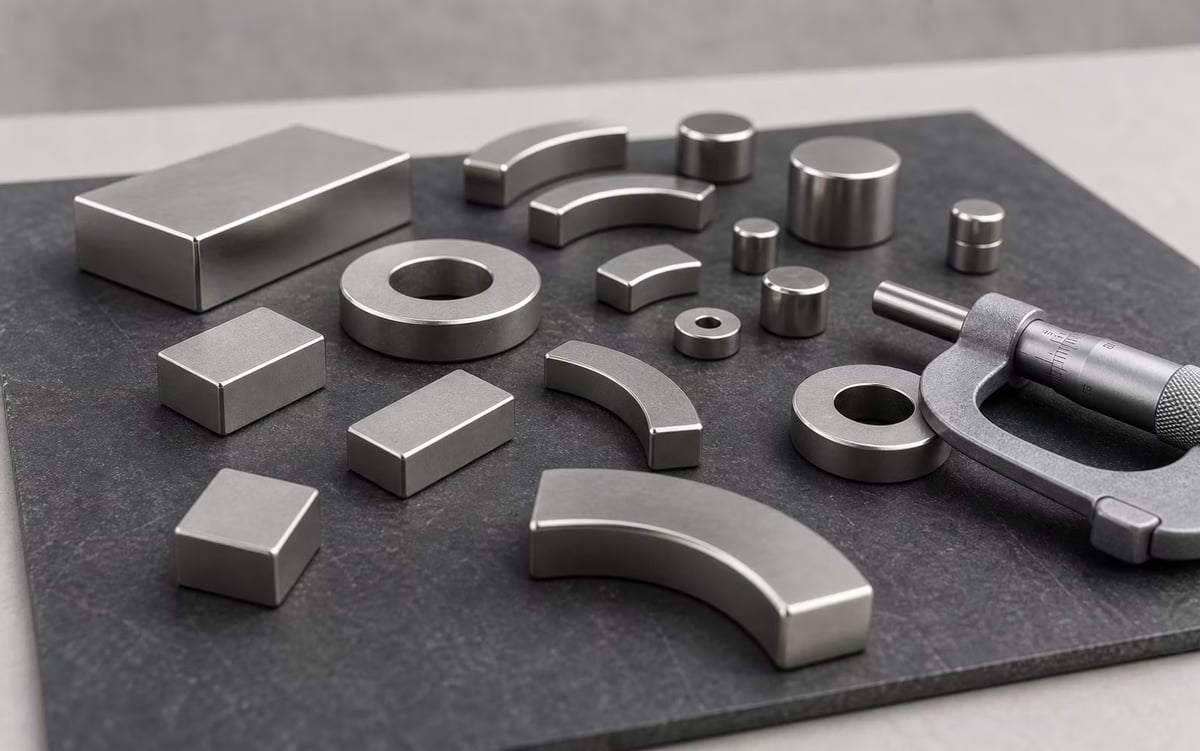
Axis Magnetics can review blocks, discs, rings, arcs, rotor segments, and other custom sintered NdFeB geometries. The review includes finished dimensions, magnetization, edge condition, coating, inspection, and the intended production program.
Can neodymium magnets be drilled or machined after delivery?
Do not treat finished neodymium magnets like ordinary metal parts. The material is brittle, machining can damage protective coatings, and grinding dust can ignite. Plan holes and finishing into the controlled production process instead.
What information helps start a neodymium magnet sourcing review?
Useful inputs include a drawing, application target, magnet temperature, grade direction, coating, magnetization, test method, volume, and qualification requirements. Start with basic contact details; Axis can discuss the technical inputs in follow-up.